
AI runtime settings
AI Runtime Settings controls the supporting models the platform uses for knowledge indexing, generation, vision tasks, and voice input. These settings apply platform-wide. Projects inherit them and cannot override them individually.
::::note Read this if you administer the platform AI configuration. Changing these settings needs the Manage Providers permission. ::::
Configure supporting models
Open Settings → AI Runtime Settings ("Configure platform-wide supporting AI settings.").
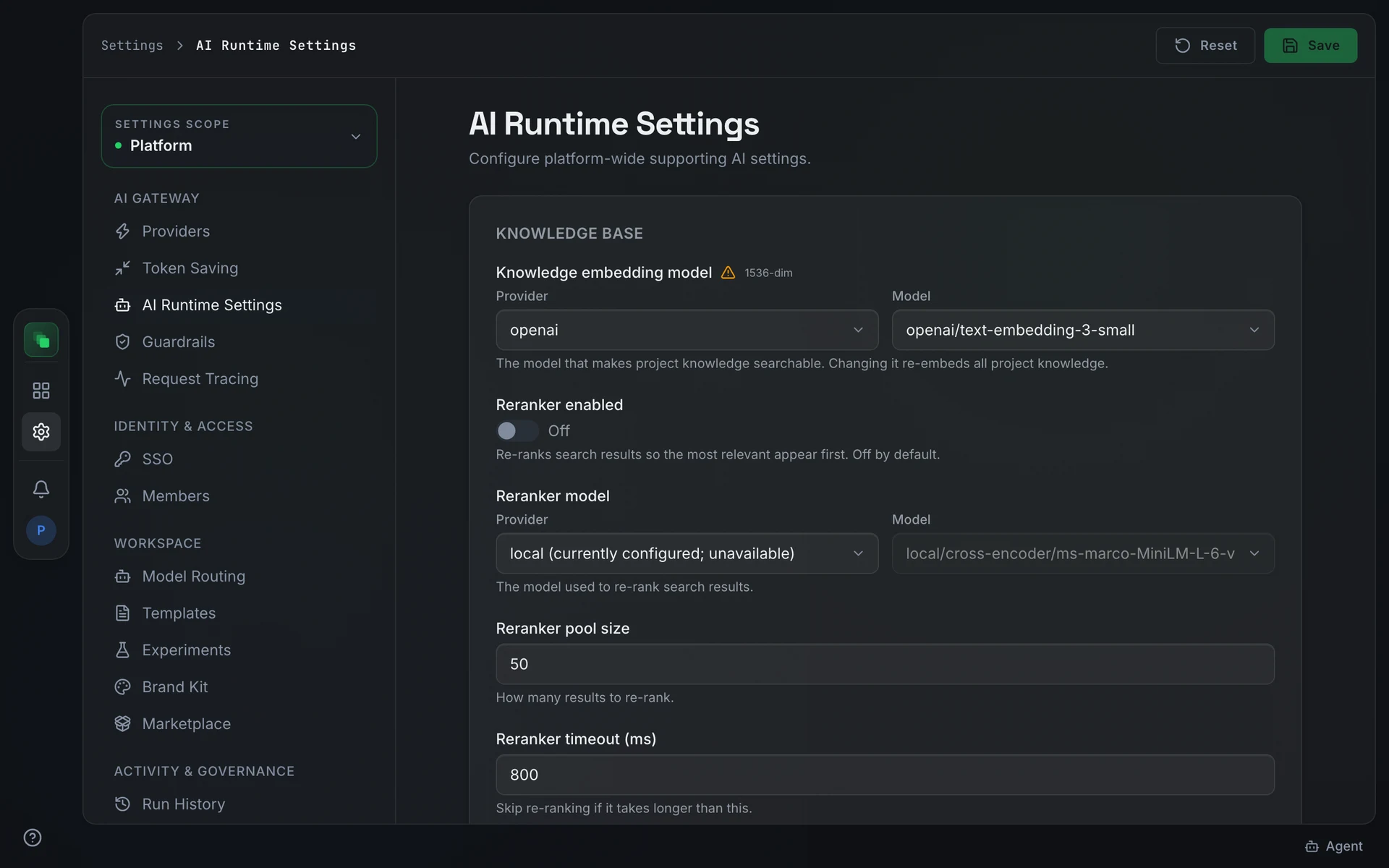
Knobs group into four sections. Each knob has a Provider and Model selector drawn from the gateway's connected providers:
If providers cannot be reached, the page shows "Configured gateway providers could not load…". If no provider exposes models, it shows "No configured gateway providers expose models. Connect a provider in AI Gateway before changing model settings."
Change the knowledge-base embedding model
Changing the Knowledge Base embedding model triggers a full re-index of all stored knowledge. Before the change takes effect, you must confirm by typing REEMBED ALL in the confirmation dialog.
Re-embedding runs as a background job. Knowledge search returns results from the previous index until the job completes.
Speech and voice settings
The page includes a Voice Input section below the AI knobs. Speech settings control the speech-to-text provider and model used for voice input across the platform.
Next steps
- AI providers: connect the providers that appear in the selectors above
- Model Routing: assign models to each type of project work
- Settings overview: how platform settings propagate to projects